New for 2026 – Recommended Wake Surfing Areas on Minocqua and Kawaga
Wake boat use has become the most controversial issue facing Lake Associations/Lake Districts in Wisconsin. Until this year, the MKLPA has remained relatively silent on this issue. Given the amount of activity occurring in other Townships across Wisconsin, we felt it was important to set out clear guidance for our two lakes.
Our current MKLPA recommendation for wake boats operating in surfing mode is tooperate in greater than 20 feet of water and greater than 500 feet from shore. Many studies have been conducted, we believe these recommendations are best practice, and a recent University of Minnesota study (excerpts below) drew the same conclusion.
Our biggest concern for the health of our two lakes isdepth of operation. Operating in less than 20 ft of water has been shown to cause significant disturbance to the lake bottom sediment. Disturbed sediment reduces water clarity and sunlight penetration, affecting aquatic plants and fish. Disturbed sediments also increase phosphorus in the water, potentially promoting algae blooms and lake weed growth, which degrade water quality.
Out of the 15,000 lakes in Wisconsin, less than 1,000 meet the criteria of being large enough and deep enough to support these recommendations for wake surfing of greater than 500 feet from shore and greater than 20 feet deep. Both Lake Minocqua and Kawaguesaga have areas that meet or exceed these recommendations.
While these guidelines are straightforward in theory, it is not that easy in practice for the average wake boat operator to comply, given the varying depth contours of our lakes. When you consider first-time visitors that are not familiar with our lakes, compliance becomes even more challenging. Also, we have heard from our MKLPA memberships that this is one of your biggest concerns – wake boats surfing in areas that are outside of these guidelines. This is why we concluded thatdesignated wake surfing areas would be the best path forward, making it EASY to comply.
How recommended wake surfing areas were chosen:While not a perfect science, MKLPA worked hard to find a good compromise that would allow for an enjoyable wake surfing experience while also improving the health and safety on our lakes.
Our process for choosing these proposed wake surfing areas included the following:
- Identify the deepest areas on both lakes.
- Identify long, straight stretches in these deep areas to allow for a convenient wake surfing experience.
- Ensure these areas were greater than 500 feet from shore at all points
- Keep areas to one or two per lake to reduce mixing with other watercraft
- Seek input from a wide variety of lake users
Getting the word out:We are not proposing that this become a town ordinance, rather, a recommendation from the MKLPA. We will need to rely on public education and word of mouth to get the word out.
MKLPA will provide copies of our revised tri-fold safety brochure to help with education, available at over 50 locations including boat landings, boat rental businesses, resorts, and Minocqua Police boat patrol officers. In addition, we will update all signage at boat landings to reflect this guidance.
Bottom line:MKLPA needs everyone on our two lakes to help spread the word and encourage wake surfing in these recommended areas for the health and safety of our two lakes. At the end of the boating season, we will seek broad feedback and determine if we need to make any changes to this guidance going forward.
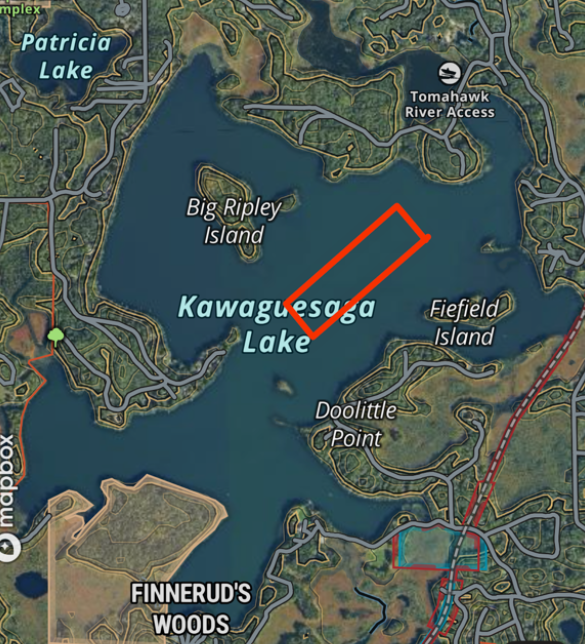
Lake Kawaguesaga recommended wake surfing area (average depth >30ft)
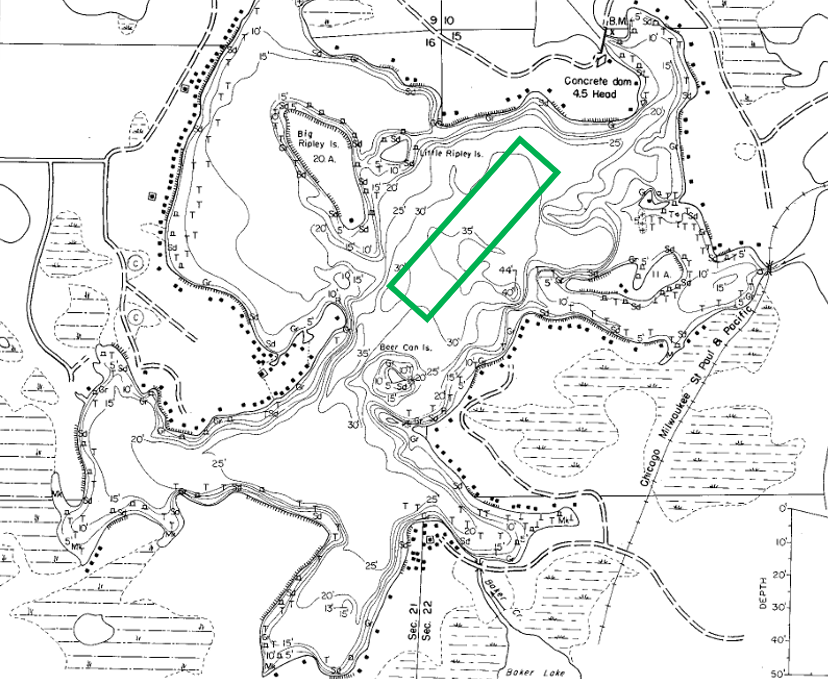
Lake Kawaguesaga depth contour map showing recommended wake surfing area
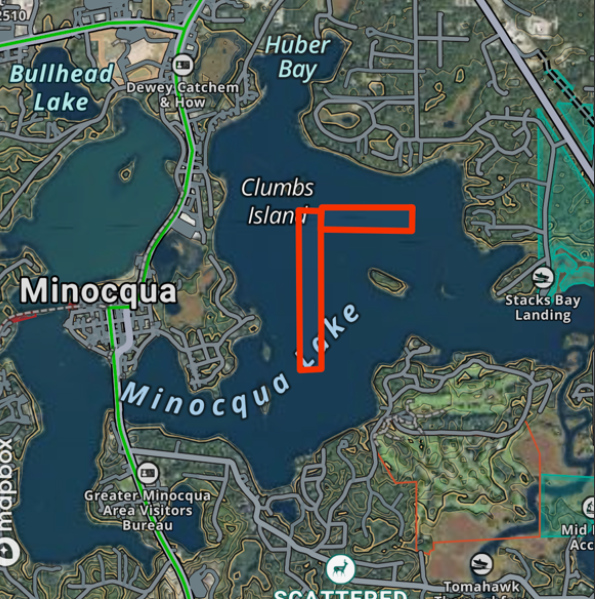
Lake Minocqua recommended wake surfing areas (average depth > 40 ft)
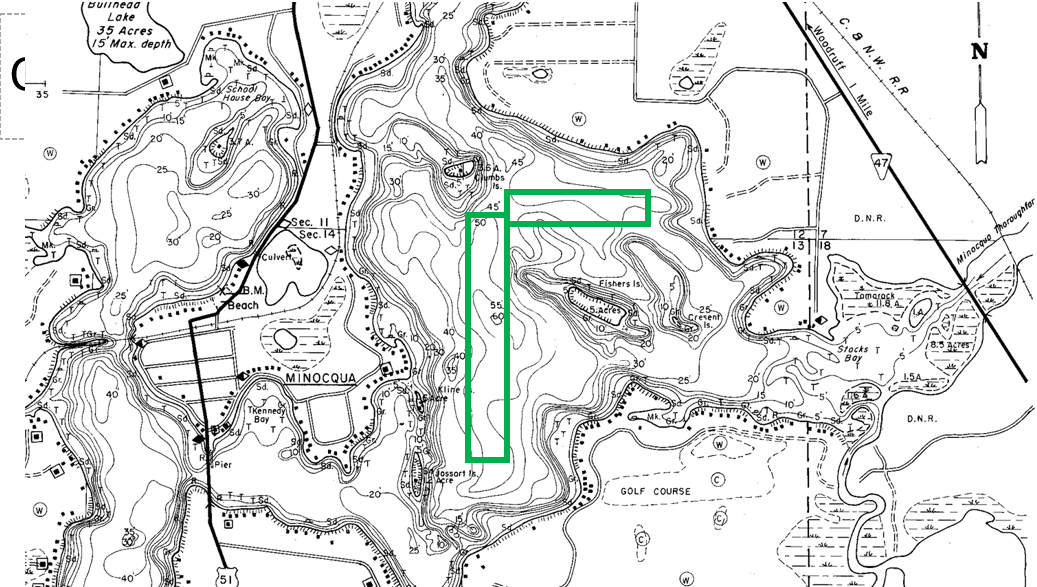
Lake Minocqua depth contour map showing recommended wake surfing areas
Excerpts from University of Minnesota wake boat impact study
Researchers at the University of Minnesota’s St. Anthony Falls Laboratory conducted a multi-phase study examining the effects of recreational powerboats, including wakesurf boats, on Minnesota lake ecosystems
The second phase, conducted in 2022 and 2023 at Lake Minnetonka, measured how seven different boat models impacted the lake bed at varying speeds and depths. This included five typical recreational boats and two wake boats at both planing speeds and slower wakesurfing speeds (10–12 mph), which create larger waves for surfing.
Distance from shore:
- When researchers compared the wake waves of the four boats during their mosttypical mode of operations, the data indicated that wakesurf boats require distancesgreater than 500 feet from the shoreline/docks and other boats (or the distance of a little less than 1.5 football fields) to decrease their wake wave characteristics to levels similar to the non-wakesurf boats.
- The suggested distance from shoreline/docks for wakesurf boats is more than twice the distance of the 200 feet currently recommended by Minnesota guidelines for common recreational boats.
- Under both slow and fast speed conditions, the wakesurf boats produced the largest waves in terms of height, energy, and power when compared to the non-wakesurf boats.
Depth of water:
- Sediment Disturbance: Wake boats operating in surfing modesignificantly stirred up sediments at depths of 9 and 14 feet. Traditional recreational boats caused similar disturbances only at shallower speeds and while cruising. Suspended sediment reduces water clarity and sunlight penetration, affecting aquatic plants and fish.
- Water Quality Impacts:Disturbed sediments can increase phosphorus in the water, potentially promoting algae blooms and lake weed growth, which degrade water quality and disrupt ecosystem balance.
- Wave Dynamics: The study identified three types of boat-generated action—pressure waves, transverse waves, and propeller wash. While all boats generated bow and stern pressure waves, wake boats uniquely created strong transverse waves and propeller wash that keep sediment suspended for extended periods—sometimes minutes to an hour.
Depth Recommendations:
- Wake boats should operate in at least 20 feet of water in surfing mode to avoid sediment disruption. This is deeper than the previously recommended depths of 10–14 feet suggested by industry-backed studies.
- Traditional recreational boats should maintain a minimum of 10 feet of water depth when cruising or planing, and reduce speed near shallow areas, docks, or landings.
- Repeated passes over the same shallow areas should be minimized to prevent prolonged sediment suspension and water quality degradation